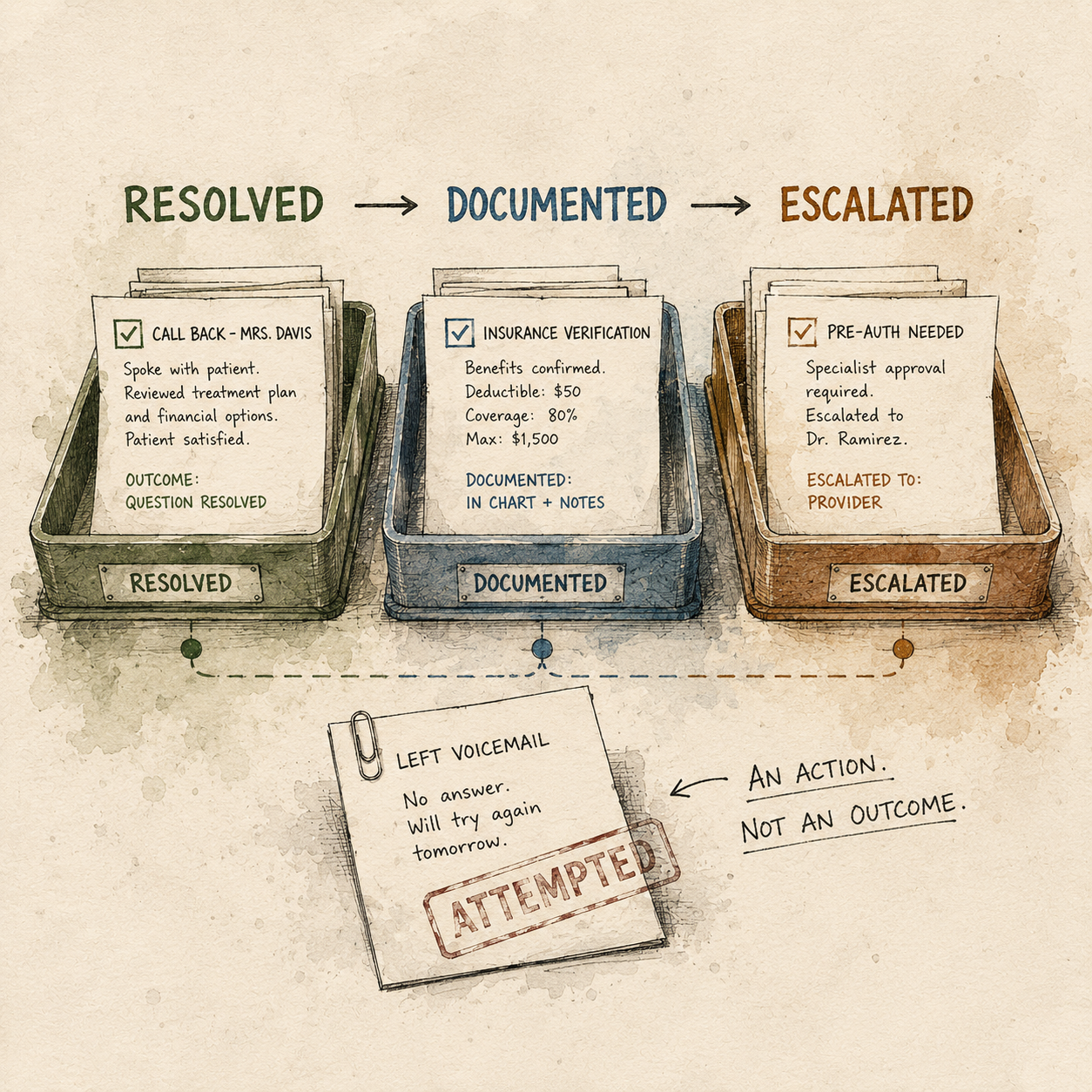
A task list can be completely checked off and still leave the practice with unfinished work.
That sounds contradictory.
It isn't.
The problem is usually hiding inside the definition of "done."
Consider a callback.
The task says:
Call Mrs. Davis.
Someone calls.
No answer.
They leave a voicemail.
The task gets marked complete.
An action happened.
But if the reason for the callback was to answer Mrs. Davis's question about her treatment plan, the intended outcome hasn't happened at all.
The call was attempted.
The question remains unresolved.
Those are two different things.
The same distinction appears everywhere in a dental practice.
Insurance verification submitted.
Patient contacted.
Message sent to provider.
Voicemail left.
Pre-authorization requested.
Follow-up attempted.
Each one describes activity.
None of them necessarily tells us whether the reason the work existed in the first place has been resolved.
That distinction matters because task-management systems are very good at recording activity.
A checkbox answers:
Did someone do something?
Operations require a different question:
Did the thing that needed to happen actually happen?
Those questions sound similar until a practice gets busy.
Then the gap between them begins accumulating.
A callback is attempted today and pushed into tomorrow.
An insurance request is submitted but the benefits aren't available before the appointment.
A patient question is forwarded to someone else without clear ownership of what happens next.
A voicemail is left and nobody knows whether another attempt is expected.
Nothing looks dramatically broken.
People are working.
Tasks are moving.
Boxes are being checked.
But unresolved outcomes are quietly traveling forward with the practice.
Tomorrow begins with some of yesterday still inside it.
This is where a clearer completion standard becomes useful.
For operational work, "done" should generally mean one of three things:
RESOLVED
The intended outcome occurred.
The patient's question was answered.
The verification was completed.
The appointment was scheduled.
The necessary information was obtained.
The work reached the endpoint it existed to produce.
DOCUMENTED
The result and the context required by the next person were recorded somewhere they can reliably be retrieved.
Documentation matters because an outcome that exists only inside one person's memory is difficult for the rest of the operation to use.
The next person shouldn't have to reconstruct what happened.
They should be able to see it.
ESCALATED
Sometimes the person responsible for the task cannot resolve the outcome themselves.
That's normal.
The problem isn't escalation.
The problem is ambiguity after escalation.
A deliberate escalation identifies who owns the work next, why it requires them, and what still needs to be resolved.
"Asked doctor" isn't necessarily an escalation system.
"Dr. Ramirez needs to approve the pre-authorization before submission; assigned for review with supporting documentation attached" is much closer to one.
The work hasn't disappeared.
Ownership has deliberately moved.
This gives us a simple operational standard:
Resolved.
Documented.
Or deliberately escalated.
And it also gives us another useful distinction:
Attempted is a status.
It isn't an outcome.
That doesn't mean attempted work has no value.
Of course it does.
Sometimes three calls are required before a patient answers.
Insurance companies don't always respond immediately.
Providers aren't always available the moment a question arrives.
Operations contain waiting, dependencies, exceptions, and work that cannot be completed in a single interaction.
The mistake is not having unfinished work.
Every practice has unfinished work.
The mistake is allowing unfinished work to look finished.
Because once that happens, the task list stops representing reality.
A manager sees completed tasks.
The front desk experiences unresolved problems.
Both can be looking at the same operation and reach completely different conclusions.
This is also why measuring productivity by activity alone can be misleading.
Twenty callbacks made sounds productive.
And it may be.
But if the operational purpose of those callbacks was to resolve twenty patient issues, another number matters too:
How many were actually resolved?
How many require another attempt?
How many were escalated?
Who owns those now?
When should they happen?
The point isn't to create more reporting.
It's the opposite.
A good completion standard reduces the amount of detective work the team has to perform later.
Nobody should have to open a task marked complete and ask:
Wait. What happened with this?
The answer should already be clear.
This is especially important as practices add people.
When two or three experienced team members work closely together, ambiguity can survive because everyone knows what everyone else means.
"Called her."
"Sent it over."
"Waiting on them."
The team fills in the missing context automatically.
As the operation grows, that becomes harder.
More people create more handoffs.
More handoffs create more opportunities for context to disappear.
And suddenly a phrase that made perfect sense to the person who wrote it means almost nothing to the person responsible for what happens next.
Clear completion standards make work portable.
The task can move between people without requiring the original person to remain attached to it.
That isn't bureaucracy.
It's operational continuity.
And importantly, none of this is about asking people to work harder.
A team can work extremely hard inside a system with a weak definition of completion.
In fact, they're often the people who feel the weakness most.
They're the ones reopening yesterday's tasks.
They're the ones asking what happened.
They're the ones calling the patient again because nobody can tell whether the first call resolved anything.
They're the ones carrying unfinished context in their heads.
The better system isn't the one with the most checkboxes.
It's the one where checking the box actually tells the practice something useful.
Did the intended outcome happen?
If yes, resolve it.
If the result needs to travel with the work, document it.
If someone else must take ownership, deliberately escalate it.
If you're still waiting for the outcome:
Keep it visible.
Because an attempted task may represent real work.
But it isn't necessarily finished work.
And "done" should mean something.
— Orion