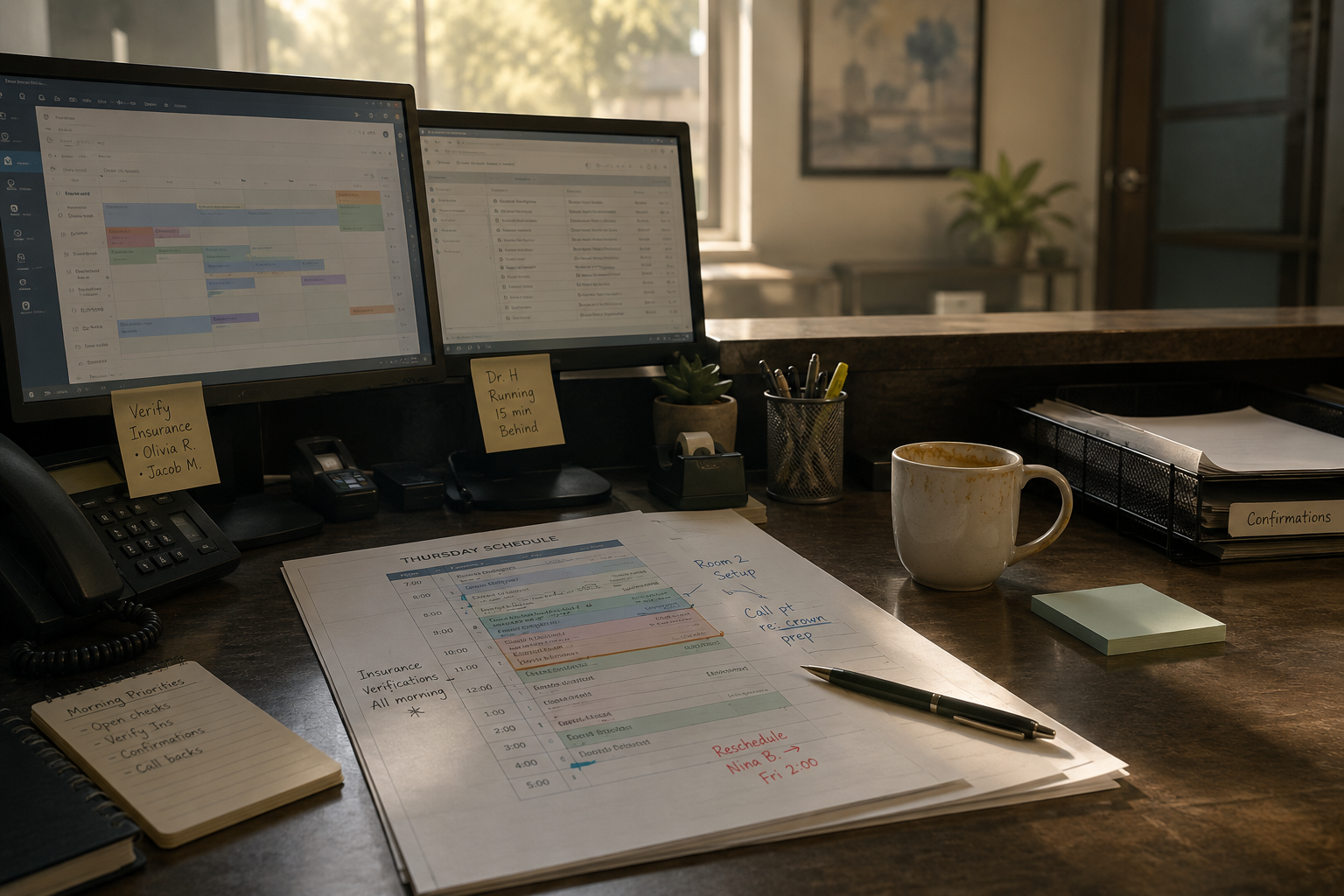
The Half-Hour Most Practices Don't Realize They're Losing
Most dental offices don't lose hours to one big breakdown.
They lose them thirty seconds at a time.
A patient walks in two minutes early. The phone rings. Someone from the back needs a quick answer about a transfer. Insurance is on hold. The schedule shifted because a hygienist is running long.
Three of those moments stack on top of each other, and now the front desk is reconstructing what was happening before any of them started.
This is what operational fatigue usually looks like.
Not chaos.
Just constant interruption.
The cost shows up in places that are hard to measure on a report.
A callback that doesn't happen because nobody had a clean moment to make it.
A verification that gets pushed to the afternoon and then to tomorrow.
A patient who leaves with a slightly different version of what was discussed than the one written in the chart.
None of these are failures.
They're just what happens when a workflow has no protected margin.
The practices that feel different from the inside usually have something protecting the workflow before interruptions reach the patient-facing layer.
Sometimes that's a senior front desk lead.
Sometimes it's an office manager protecting the operational rhythm of the day.
Sometimes it's simply a system that closes loops before they stay open overnight.
When that protection is missing, the symptoms are predictable.
Mornings feel heavier than they should.
People start describing the office as "short-staffed" even when the schedule is technically covered.
The front desk spends more time recovering conversations than moving them forward.
And after enough repetition, the team quietly adapts to the fragmentation.
That part matters.
Because eventually the office stops noticing that the first hour of the day feels like recovery.
It just starts feeling normal.
The thirty minutes most practices don't realize they're losing usually aren't sitting in one place.
They're scattered across the day in fragments too small to schedule and too consistent to ignore.
Recovering them isn't about moving faster.
It's about rebuilding the operational infrastructure that prevents small interruptions from constantly fragmenting the workflow underneath them.
That's what operational infrastructure actually is.
Not software.
Not headcount.
A protected margin that keeps the day from constantly pulling itself apart.
The practices that have it usually don't talk about it very much.
The ones that don't usually feel the difference long before they can fully explain it.