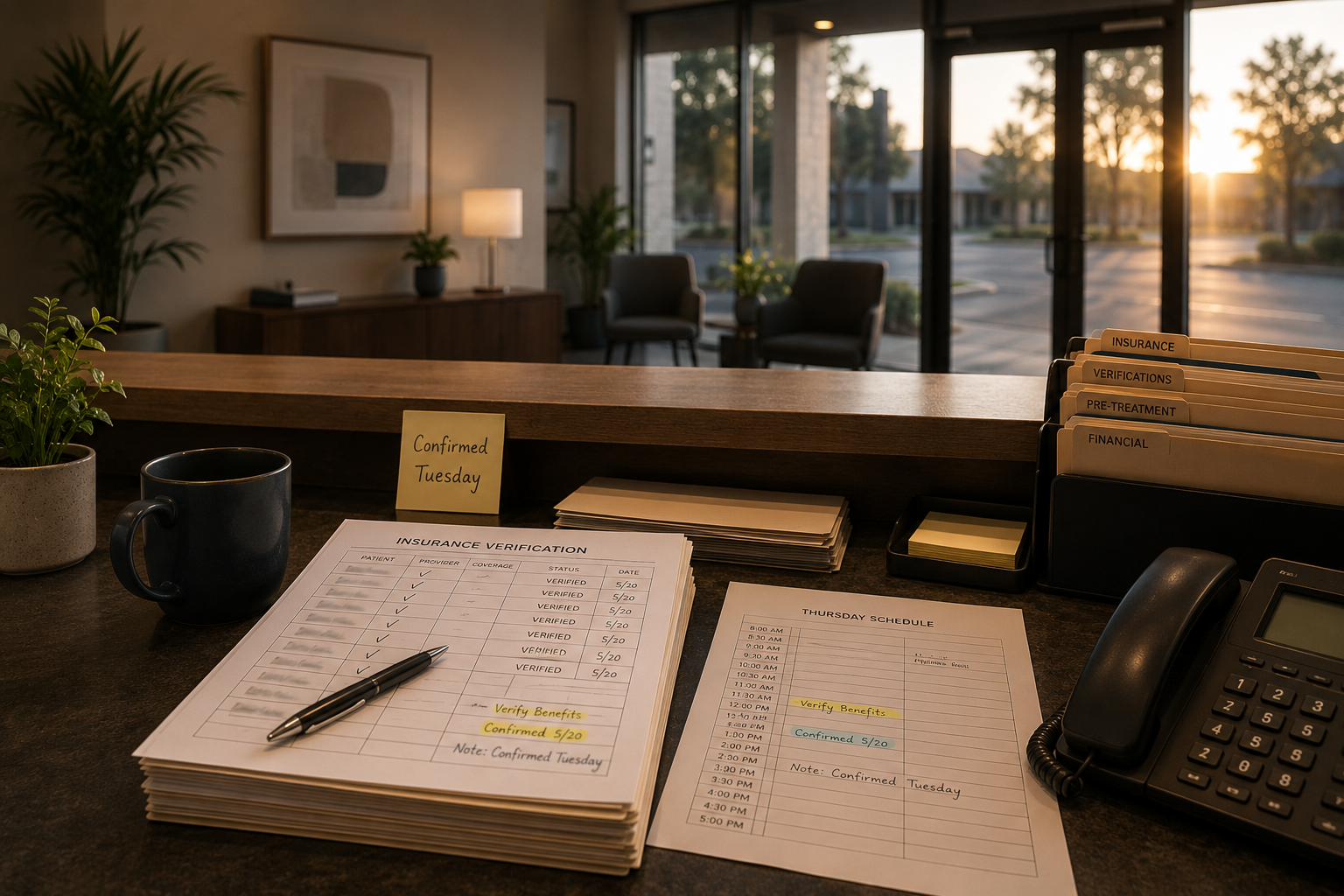
Most dental offices have a moment in their morning where insurance verification becomes a bottleneck.
Someone calls the insurance company.
The line is long.
The hold time stretches.
And by the time verification actually happens, the schedule has already shifted around it.
The appointment is still tentative.
The patient's portion is still unknown.
The front desk is still carrying uncertainty into the appointment.
What most practices don't realize is that this isn't a phone system problem.
It's a continuity problem.
Because the issue isn't whether verification gets attempted.
It's whether verification gets confirmed before the patient arrives.
There's a massive operational difference between:
- "We tried to verify insurance" (attempted)
- "Insurance verification is confirmed and in the chart" (completed)
One leaves the front desk reactive.
The other lets them move forward.
Most dental offices are organized around attempted work.
A verification gets started.
A callback gets attempted.
A follow-up gets sent.
But somewhere between attempted and confirmed, the work stops being tracked.
And the front desk ends up carrying the uncertainty all day.
When a practice shifts to organizing around confirmed work, everything changes.
Insurance verification isn't done when someone called the company.
It's done when the result is in the chart, the patient's portion is calculated, and the front desk can walk into the appointment without surprise.
A callback isn't done when a voicemail was left.
It's done when the patient is rescheduled, opted out, or escalated.
A follow-up sequence isn't done when an email was sent.
It's done when the patient either booked or got moved into a longer-cycle reactivation list.
This sounds like a semantic difference.
In practice, it changes the entire emotional texture of the front desk.
Because when work is organized around completion, the front desk stops carrying unfinished things.
They stop walking into Tuesday morning with a pile of verifications that were "attempted" on Friday.
They stop feeling like they're constantly rebuilding continuity.
They stop feeling reactive.
Instead, they walk in to a cleared queue.
Verifications are confirmed.
Callbacks are resolved or escalated.
Follow-ups have moved patients forward.
And the morning feels like it has operational breathing room.
That's the difference between a practice that feels like it's constantly catching up, and a practice that feels like it's actually moving forward.
It's not about working harder.
It's about organizing work around what actually gets finished, not what gets attempted.
Most dental offices are ready for that shift.
They're just waiting for someone to help them build the systems that make it possible.
Systems where insurance verification doesn't just get attempted.
It gets confirmed.
Before Tuesday even arrives.