When a practice starts feeling heavier than it used to, the response is almost always the same.
Hire someone.
Buy better software.
Tighten the schedule.
Restructure the morning huddle.
Most owners cycle through some version of this list — sometimes more than once — before they realize the problem they're trying to solve might not be the problem they actually have.
The pattern is consistent enough to be recognizable.
A practice grows.
The day starts feeling slightly off — not broken, just heavier.
The front desk seems busier without obviously producing more.
Conversations about workflow start with:
"we used to."
Mornings feel like they're catching up from somewhere instead of starting fresh.
The owner notices, and reaches for the most visible lever available.
Usually it's headcount, because burnout and turnover are the most visible symptoms.
Sometimes it's software, because there's always another platform promising to solve what the current one isn't solving.
Occasionally it's process:
a new SOP,
a new checklist,
a new accountability layer.
Some of these moves help.
Most don't help as much as expected.
A few make things worse.
The reason isn't that the solutions are bad.
It's that the problem most practices are diagnosing —
"we don't have enough capacity" —
usually isn't the thing creating the drag.
The actual problem, in most cases, is where the work lives.
Practices grow by adding visible capacity at the front of the workflow.
More chairs.
More providers.
More appointments.
More patients.
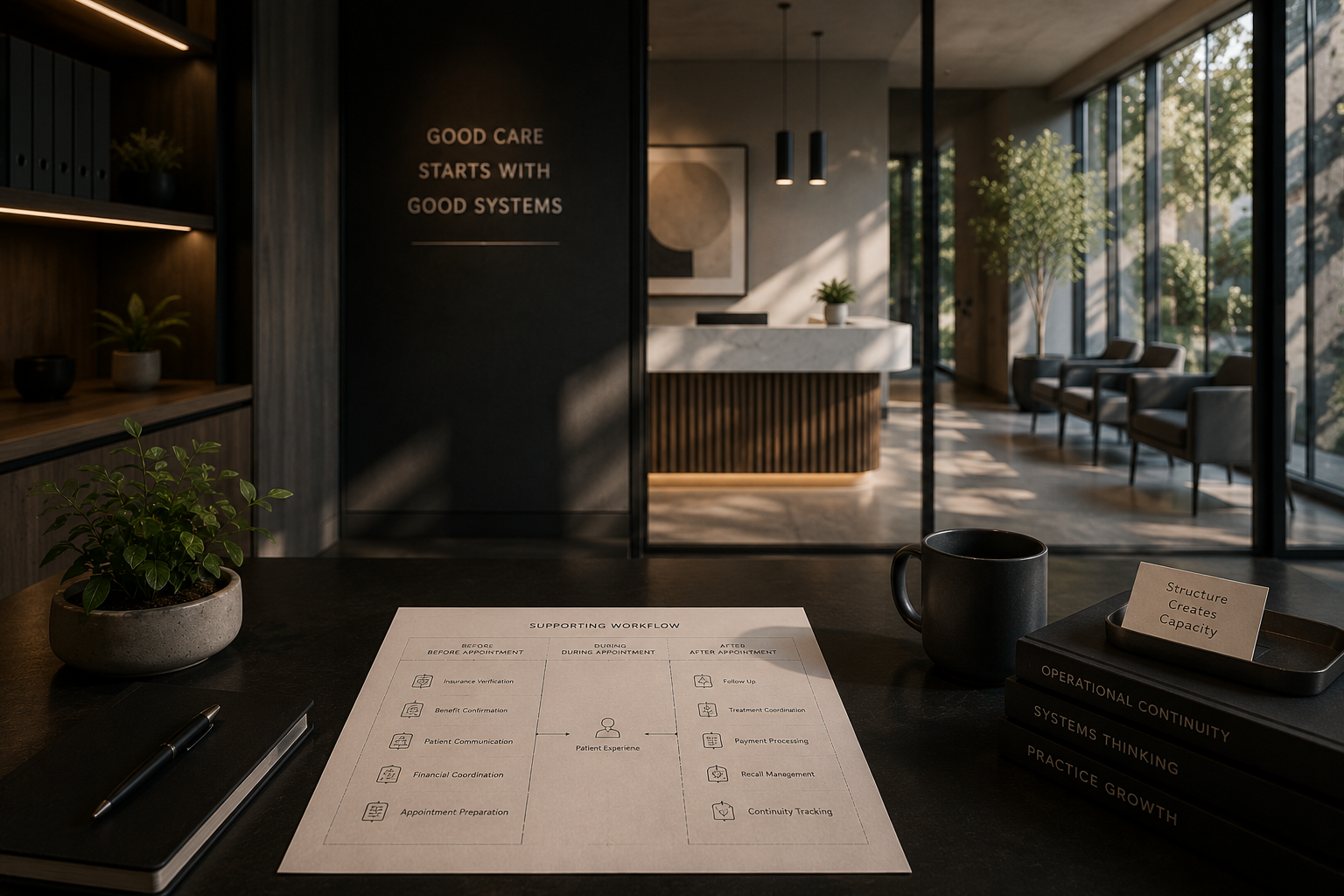
The work supporting those things —
verifications,
callbacks,
follow-up sequences,
communication continuity,
scheduling logistics —
usually doesn't grow proportionally.
It stays where it always was:
distributed across the same front desk team,
fit between patient-facing moments,
absorbed into whatever margin those people can find.
When the practice was smaller, that worked.
There was margin.
As the practice grew, the margin closed.
The supporting work didn't disappear.
It just started competing for attention with the patient-facing work.
Verifications started happening during the appointment cycle instead of before it.
Callbacks started piling up during the day instead of getting cleared beforehand.
Communication became reactive instead of staying ahead.
From the inside, this feels like understaffing.
The obvious fix becomes adding another person.
But adding another person into the same operational structure usually doesn't solve the underlying problem.
It just creates one more person trying to manage the same fragmented supporting work under the same pressure.
The fix is structural.
The supporting work needs to live somewhere different.
It needs to happen before the appointment cycle starts, not during it.
It needs its own operational layer.
Its own visibility.
Its own timing.
Its own definition of done.
This is what operational infrastructure actually does.
Not replace the front desk.
Not absorb labor.
Separate the supporting work from the patient-facing work so growth doesn't force them to compete for the same operational margin.
When that separation exists, hiring works the way owners expect hiring to work.
New people add visible capacity instead of absorbing invisible overflow.
Software creates leverage instead of simply creating another place for things to slip through.
Processes hold their shape instead of collapsing the moment the day gets busy.
When that separation doesn't exist, no amount of hiring, tooling, or process work fully removes the heaviness.
It just moves the pressure somewhere else.
The practices that scale cleanly are usually the ones that figured out how to separate the supporting layer from the visible workflow.
The ones that struggle aren't underbuilt.
They're structured for the size they used to be.