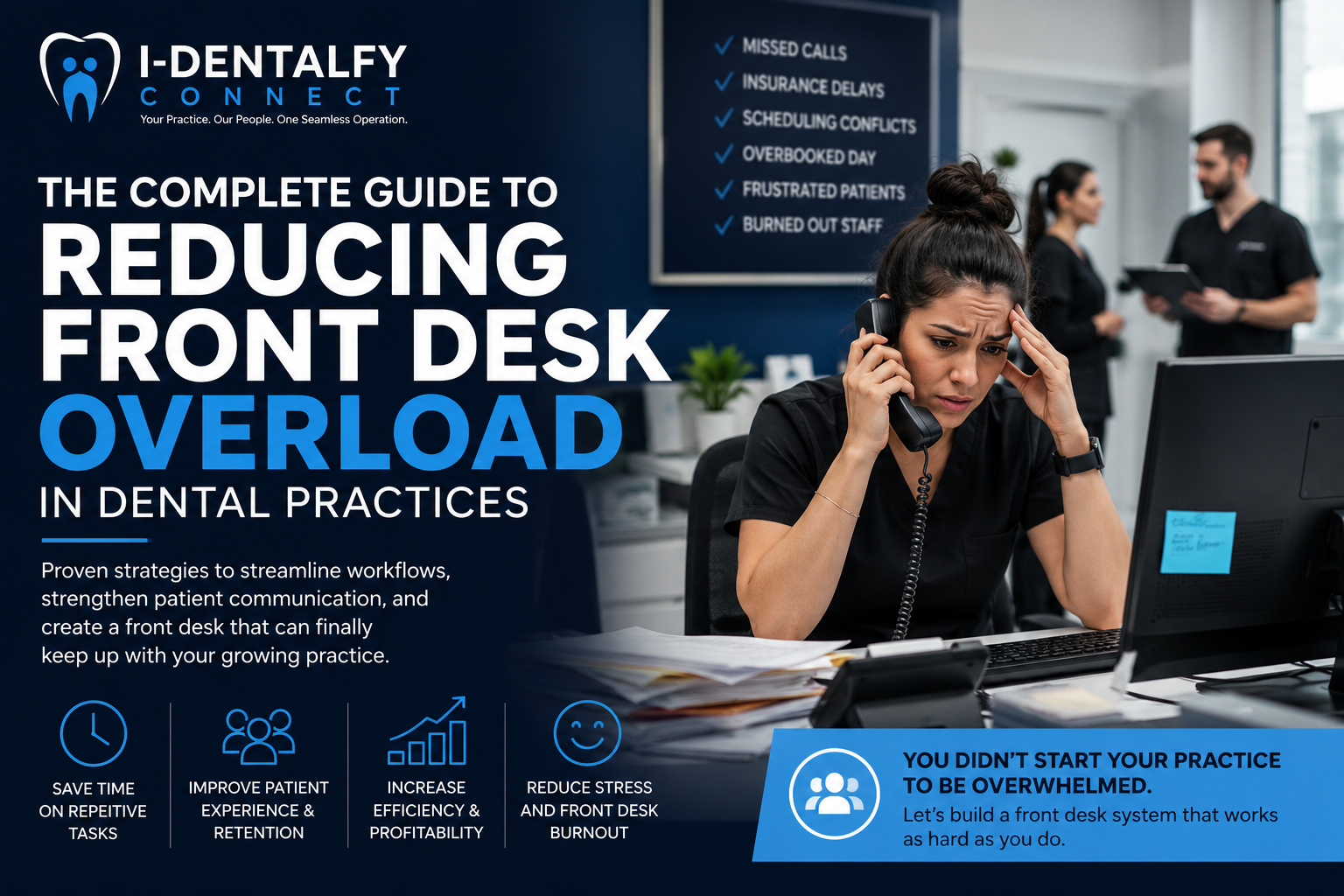
The Hidden Cost of an Overwhelmed Front Desk
Every dental practice owner knows the feeling: phones ringing off the hook, patients waiting to check in, insurance forms piling up, and a front desk team stretched impossibly thin. Front desk overload isn't just a staffing inconvenience — it's a systemic operational failure that quietly drains revenue, damages patient relationships, and accelerates staff burnout.
The numbers tell a sobering story. Research shows that the average dental practice misses approximately 300 calls per month, with 20–38% of all incoming calls going unanswered during business hours. Each missed new patient call represents an immediate $850 revenue loss, with the lifetime value of that patient reaching up to $8,000. Annually, this translates to $100,000–$150,000 in lost revenue for a single practice.
This guide examines the root causes of front desk overload and provides actionable strategies to build a communication system that scales with your practice.
Recognizing the Warning Signs
Front desk overload rarely announces itself with a single dramatic failure. Instead, it manifests through a pattern of small, compounding breakdowns:
Missed and abandoned calls. When your team cannot answer the phone within three rings, callers hang up — and 75% of them never call back. Only 14% of new patients will leave a voicemail, meaning the vast majority of missed opportunities disappear silently.
Scheduling conflicts and gaps. An overwhelmed front desk makes booking errors, double-books providers, or leaves hygiene chairs unfilled because follow-up calls never happened.
Insurance verification delays. When verification is squeezed between phone calls and patient check-ins, claims go unverified, leading to denied treatments, patient frustration, and delayed revenue.
Rising patient complaints. Long hold times, unreturned calls, and disorganized check-in experiences erode trust. Patients who feel ignored leave negative reviews and switch providers.
Staff turnover. Front desk burnout is one of the leading causes of turnover in dental practices. Replacing a trained front desk employee costs $3,000–$5,000 in recruiting, training, and lost productivity.
Understanding the True Financial Impact
The cost of front desk overload extends far beyond the obvious. Consider the full picture:
| Impact Area | Annual Cost Estimate |
|---|---|
| Missed new patient calls (at $850 each) | $50,000–$100,000 |
| Unfilled hygiene appointments | $30,000–$60,000 |
| Insurance claim denials from late verification | $15,000–$25,000 |
| Staff turnover and retraining | $6,000–$15,000 |
| Lost patient lifetime value | Incalculable |
Nearly 80% of missed calls relate directly to appointment bookings, and 65% come from potential new patients. These aren't spam calls or vendor solicitations — they're people actively seeking dental care and ready to commit.
When a practice misses 120 new patient calls annually, the compounding revenue loss over a seven-year period can exceed $700,000.
Why Traditional Solutions Fall Short
Most practices respond to front desk overload with one of three approaches — all of which have significant limitations:
Hiring additional staff. Adding another full-time front desk employee costs $35,000–$50,000 annually in salary, benefits, and overhead. Even then, coverage gaps persist during lunch breaks, sick days, and high-volume periods.
Voicemail and call-back systems. As noted, only 14% of new patients leave voicemails. Automated call-back systems help, but they cannot replace the immediate human connection that converts callers into booked appointments.
Asking existing staff to "do more." This approach accelerates burnout without addressing the structural problem. When one person handles phones, check-in, check-out, insurance verification, and patient questions simultaneously, quality suffers across every function.
Building a Scalable Front Desk System
The practices that thrive are those that redesign their front desk operations around three principles: specialization, redundancy, and workflow separation.
1. Separate Phone Operations from In-Office Tasks
The single most impactful change a practice can make is ensuring that phone calls never compete with in-person patient interactions. This can be achieved through:
- Dedicated phone personnel who handle nothing but incoming and outgoing calls
- Remote support teams trained in dental scheduling, insurance questions, and patient communication
- Overflow call handling during peak hours (typically 9–11 AM and 2–4 PM)
Practices that implement dedicated phone support report a 35–45% reduction in missed calls within the first month.
2. Systematize Insurance Verification
Insurance verification is one of the most time-consuming front desk tasks, yet it's often treated as an afterthought squeezed between other duties. A structured approach includes:
- Verifying benefits 48–72 hours before every scheduled appointment
- Using standardized verification checklists for consistency
- Assigning verification to dedicated personnel rather than splitting it across the team
- Documenting coverage details in the practice management system immediately
When verification is handled proactively, same-day cancellations due to coverage surprises drop significantly, and treatment acceptance rates improve.
3. Implement Structured Patient Follow-Up
Unscheduled treatment and overdue hygiene patients represent a massive revenue opportunity that overwhelmed front desks simply cannot pursue. A systematic follow-up program includes:
- Next-day follow-up calls for patients who didn't schedule at checkout
- 48-hour reactivation outreach for cancelled or no-show appointments
- Monthly hygiene recall campaigns for overdue patients
- Post-treatment check-in calls that reinforce care quality
These touchpoints require dedicated time and attention that a multitasking front desk cannot provide consistently.
4. Leverage Technology Strategically
Technology should reduce cognitive load on your team, not add complexity:
- Online scheduling allows patients to self-book routine appointments, reducing inbound call volume by 15–25%
- Automated appointment reminders via text and email reduce no-shows by up to 30%
- Digital intake forms eliminate manual data entry at check-in
- Call tracking and analytics provide visibility into missed call patterns and peak volume times
However, technology alone cannot replace the human judgment required for complex scheduling, insurance questions, and patient relationship management.
5. Create Redundancy Through Remote Support
The most resilient dental practices build redundancy into their communication systems. Remote dental support professionals — trained in your practice management software, scheduling protocols, and patient communication standards — provide:
- Consistent phone coverage during all business hours without gaps
- Overflow capacity during high-volume periods
- Coverage during staff absences, vacations, and turnover transitions
- Specialized focus on phone-based tasks without in-office distractions
This model allows in-office staff to focus entirely on the patient experience while ensuring every call is answered professionally.
Measuring Success: Key Metrics to Track
Once you implement changes, monitor these operational indicators:
Call answer rate. Target 90%+ of calls answered within three rings. Track this weekly.
New patient conversion rate. What percentage of new patient callers actually book? Industry benchmark is 80%+.
Schedule fill rate. Are hygiene chairs and provider schedules consistently full? Track utilization weekly.
Insurance verification completion rate. What percentage of next-day appointments have verified benefits? Target 100%.
Patient satisfaction scores. Monitor online reviews and patient feedback for communication-related complaints.
Staff retention. Reduced workload should correlate with improved retention over 6–12 months.
The Path Forward
Front desk overload is not an inevitable consequence of practice growth. It's a solvable operational challenge that requires intentional system design rather than incremental band-aids.
The practices that invest in building scalable front desk operations — through workflow specialization, dedicated communication support, and strategic technology — consistently outperform those that continue asking their teams to do more with less.
Every missed call, every delayed verification, every unfilled appointment slot represents revenue that walked out the door. The question isn't whether your practice can afford to fix this problem — it's whether you can afford not to.
Ready to explore how a dedicated support team can strengthen your front desk operations? Schedule a discovery conversation — no pressure, just clarity on what's possible for your practice.