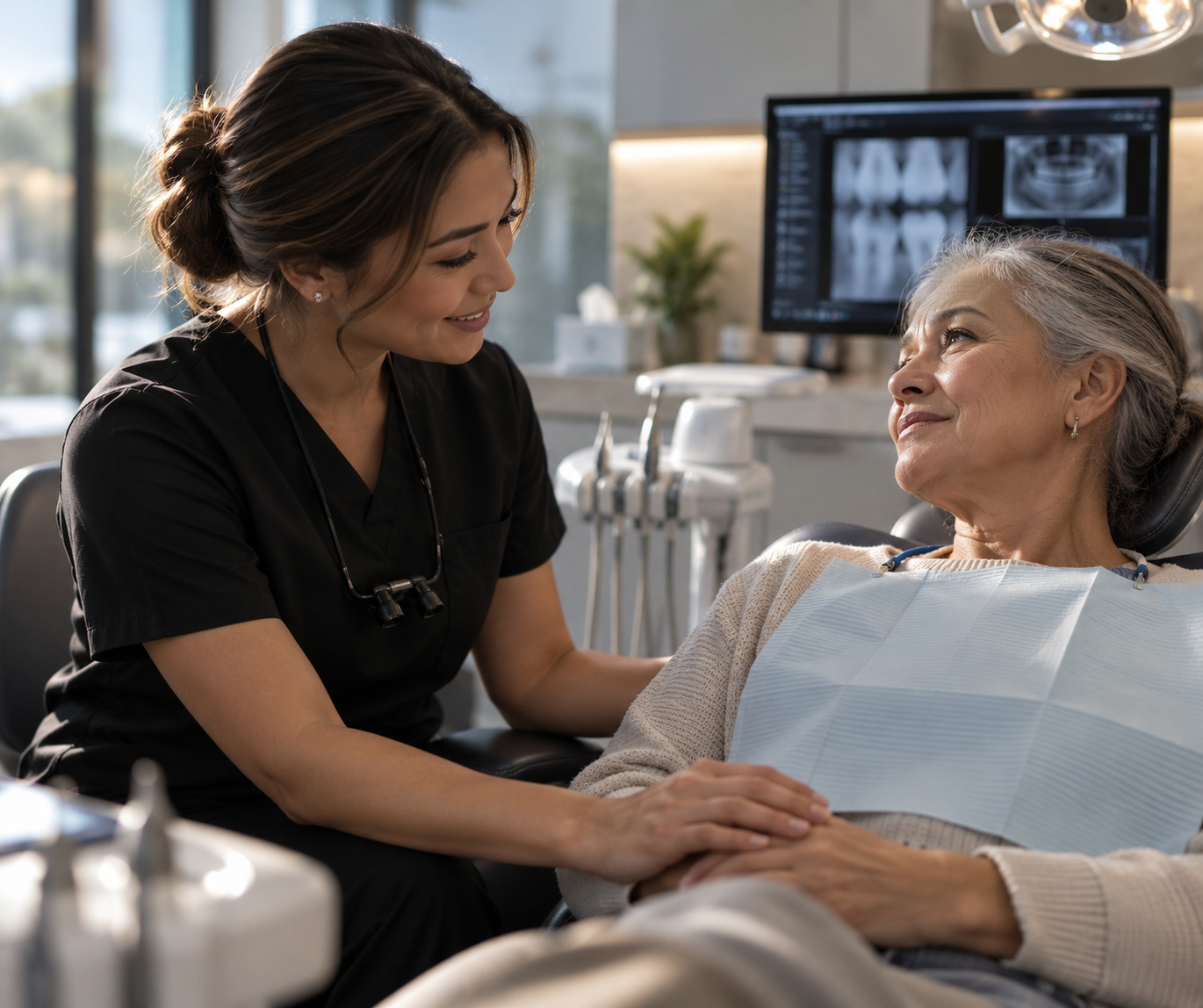
A dentist asked me an interesting question recently: Will AI eventually replace the people working in dental practices?
Some of the tasks people perform today? Almost certainly.
People themselves? I think the more interesting answer is no—at least not in the dental practices trying to deliver an exceptional patient experience.
There is a tendency to discuss AI primarily through the lens of substitution. If software can answer the phone, schedule an appointment, send a reminder, verify information or respond to a common question, the natural next question is how many people the practice will eventually need.
That may be the wrong question.
A better one is what the people inside the practice could do differently if technology handled more of the work that doesn't actually require a person.
Dentistry isn't a purely transactional business. Patients arrive nervous. They worry about pain, cost and what the dentist is going to find. They postpone treatment they know they probably need. They ask questions whose literal answers may be simple, but whose real purpose is reassurance.
A patient asking whether a procedure will hurt isn't always looking for information about anesthetic. Sometimes they're asking whether they're going to be okay.
A patient hesitating over a treatment plan isn't necessarily asking for the financing options to be repeated. Sometimes they need someone to recognize that they're overwhelmed.
And when a patient calls after treatment because something doesn't feel right, the quality of the interaction isn't measured only by how quickly the call gets routed. They want to feel that somebody cares about what happens next.
That is where the conversation about AI in dentistry becomes more nuanced.
There are many things technology can probably do faster and more consistently than a person. It can organize information, trigger reminders, identify unfinished work, summarize conversations, surface the right information and automate repetitive administrative steps. As these systems improve, the list will get longer.
Practices should take advantage of that.
But efficiency and experience aren't the same objective.
If every technological improvement is evaluated primarily by how many human interactions it can eliminate, a practice can become more efficient while simultaneously becoming less personal.
For some businesses, that trade may be acceptable.
Dentistry is different.
A patient's relationship with a dental practice contains a degree of vulnerability that doesn't exist when ordering a product online. Someone is going to examine them physically, discuss their health, recommend treatment and often ask them to make a significant financial decision.
Trust matters.
And trust is frequently built in small interactions that would be difficult to capture on an efficiency dashboard.
It's the person who remembers that the patient was nervous last time. It's the team member who hears hesitation in someone's voice and slows the conversation down. It's the front desk person who notices that an elderly patient looks confused and walks around the counter instead of pointing down the hallway. It's the treatment coordinator who realizes the patient isn't rejecting the treatment plan; they're afraid of it.
None of these interactions are particularly efficient.
That's partly why they're valuable.
The opportunity for AI, then, may not be to engineer these moments out of the practice. It may be to remove enough administrative friction that people have more capacity for them.
Imagine a front desk where technology handles more of the repetitive information retrieval, routine documentation and workflow monitoring happening in the background.
The person at the desk doesn't disappear.
Their attention becomes available.
They can look up when a patient walks in. They can listen instead of typing through half the conversation. They can spend an extra minute explaining something without simultaneously worrying about five administrative tasks accumulating behind them.
The same principle applies throughout the practice.
Technology can help people remember. It can help them prepare. It can reduce repetitive work. It can make information easier to retrieve and unfinished work harder to lose.
But the outcome of that efficiency doesn't have to be fewer human moments.
It can be better human moments.
This is especially relevant for practices that want to position themselves at the premium end of dentistry.
Premium doesn't mean refusing automation. A practice that forces patients through unnecessary manual processes isn't more personal simply because a human is involved.
The goal isn't human interaction everywhere.
It's human interaction where being human adds something.
Let technology handle the work where speed, consistency and automation improve the experience. Let people own the moments where judgment, empathy, reassurance and genuine attention improve it.
That division will continue changing as AI becomes more capable. Some tasks that require people today won't require them tomorrow, and practices should be willing to rethink how work gets done.
But the most sophisticated practices may discover that AI creates a different kind of competitive advantage than simply lowering labor costs.
It can create room for hospitality, attention and conversation—the small moments patients remember when deciding whether a practice actually cares about them.
The future dental practice may contain considerably more technology than the one we know today.
It doesn't have to feel less human because of it.
In the best practices, I suspect the opposite will happen.
The technology will become less visible.
And the humanity will become more noticeable.