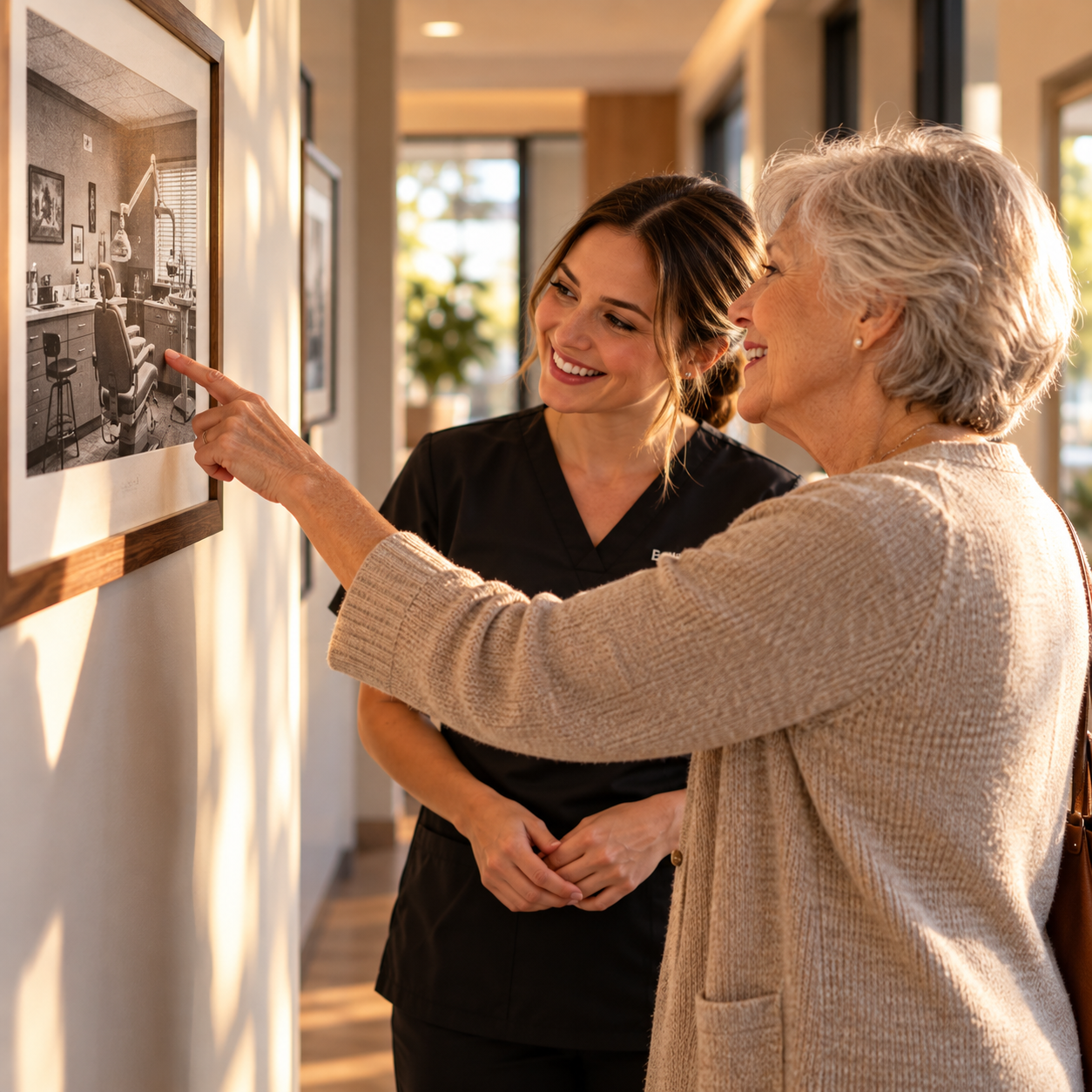
“Oh, this used to be where the front desk was.”
The patient points toward a section of the office that hasn't been the front desk for years. The employee standing beside her smiles, but she has no memory of it. She started working here two years ago. The renovation happened eight years ago.
For a moment, the patient knows something about the practice that the employee doesn't.
Every established dental office eventually has patients like this. They've been coming long enough to remember a version of the practice that no longer exists. They remember the old waiting room, the receptionist who retired, the hygienist who moved away, or the operatory that used to look completely different. Some remember when the practice was smaller. Others remember when the dentist's children were little because they used to see their pictures at the front desk.
None of this appears on a production report. It doesn't fit particularly neatly into the way we usually talk about patient retention either.
We tend to measure retention numerically. How many active patients remain in the practice? How many are returning for hygiene? How many leave without scheduling their next visit? Those numbers matter, but they describe only one part of what it means for someone to keep choosing the same dental office for ten, fifteen or twenty years.
A longtime patient hasn't simply attended a large number of appointments. They've experienced the practice across time.
That's different.
Employees often experience a dental practice in chapters. Someone joins the team in 2024 and knows the practice from that point forward. Another person worked there from 2012 until 2019 and remembers an entirely different chapter. A dentist who founded the practice may be one of the only people who can see the whole timeline.
Patients have chapters too, but some of theirs are surprisingly long.
A patient may remember employees the current team has never met. She may remember an insurance conversation from years ago, the afternoon someone squeezed her in before a vacation, or the hygienist who always asked about her son. She may remember when an operatory was added or when the office finally replaced those chairs everybody used to joke about.
Most of those memories don't need to become data.
A practice doesn't need to document every personal conversation, preserve every preference forever or turn ordinary human relationships into fields inside a CRM. Trying to capture everything would probably make the relationship feel less human rather than more.
But there is another kind of history that does need to survive change.
A previous treatment conversation should still make sense when someone looks at it later. A commitment made to a patient shouldn't disappear because the person who made it is no longer there. Relevant preferences shouldn't have to be rediscovered at every visit. If a patient calls about something discussed three weeks ago, the person answering today should have enough context to understand where the conversation left off.
That's where continuity becomes operational.
The practice doesn't need every employee to remember everything. It needs important information to live somewhere other than one person's memory.
That distinction matters because dental practices inevitably change.
People retire. Employees move. Someone has a baby and decides not to return. A great team member gets an opportunity somewhere else. New software replaces old software. Responsibilities shift. The practice grows. The office is remodeled. A second doctor joins. The person who answered almost every phone call for nine years eventually stops answering them.
None of those changes necessarily represent a problem.
In many cases, they're signs of a healthy organization continuing to evolve.
The problem begins when ordinary change repeatedly requires the patient to reconstruct the relationship.
Imagine calling a practice you've visited for twelve years and realizing that the person who understood a recurring insurance issue is gone. That's understandable. People leave.
What's frustrating is discovering that the understanding left too.
Now you're explaining the situation again. Then you're explaining what happened last year. Then you're trying to remember what someone told you during a previous conversation because nobody can quite find it.
The patient becomes the practice's institutional memory.
That's a burden they shouldn't have to carry.
There is an important distinction here, because continuity does not mean making people interchangeable.
They're not.
A hygienist who has cared for someone for twelve years cannot be replaced by a detailed note. A receptionist who knows three generations of the same family brings something to those relationships that no workflow can recreate. A dentist who remembers asking about a patient's new grandchild at the last appointment is doing something human, not operational.
Those relationships matter precisely because they're personal.
Good systems shouldn't flatten them.
They should protect the environment around them.
When important operational information is accessible, the human relationship doesn't have to carry everything else with it. When ownership is clear, a trusted employee doesn't have to become the only person capable of moving something forward. When previous conversations can be understood, a new employee can continue helping someone without pretending to possess a history they don't have.
The goal isn't to make Maria replaceable.
It's to make sure that when Maria eventually leaves, the patient doesn't discover that half the practice left with her.
That is a different kind of resilience.
It also allows a practice to change without becoming unfamiliar every time it does.
Continuity isn't sameness.
A dental practice that's been open for twenty-five years should probably look different than it did twenty-five years ago. The technology should be better. Some processes should be better. The team will be different. The software will certainly be different. Even the way patients communicate with the practice may have changed several times.
Trying to preserve everything would be absurd.
The achievement is allowing all of that change to happen while preserving enough context, reliability and human recognition that longtime patients don't feel like they're repeatedly being introduced to a new organization.
That's why the patient pointing at the old photograph is such an interesting image.
She remembers that room.
The employee beside her doesn't.
One of them knows the practice as it was. The other knows it as it is. Neither perspective is more legitimate than the other. They're simply standing in different places on the same timeline.
Maybe the patient tells her about the receptionist who used to sit there. Maybe there's a funny story about the old waiting-room furniture. Maybe she points out something in the photograph that nobody on the current team would have noticed.
The younger employee listens.
For a minute, the patient isn't just someone with a chart in the system. She's part of the history of the place.
Then the conversation ends. The patient continues with her appointment, and the practice continues with its day.
Tomorrow someone new may walk through the door for the first time.
Twenty years from now, they might be the person pointing at a photograph.