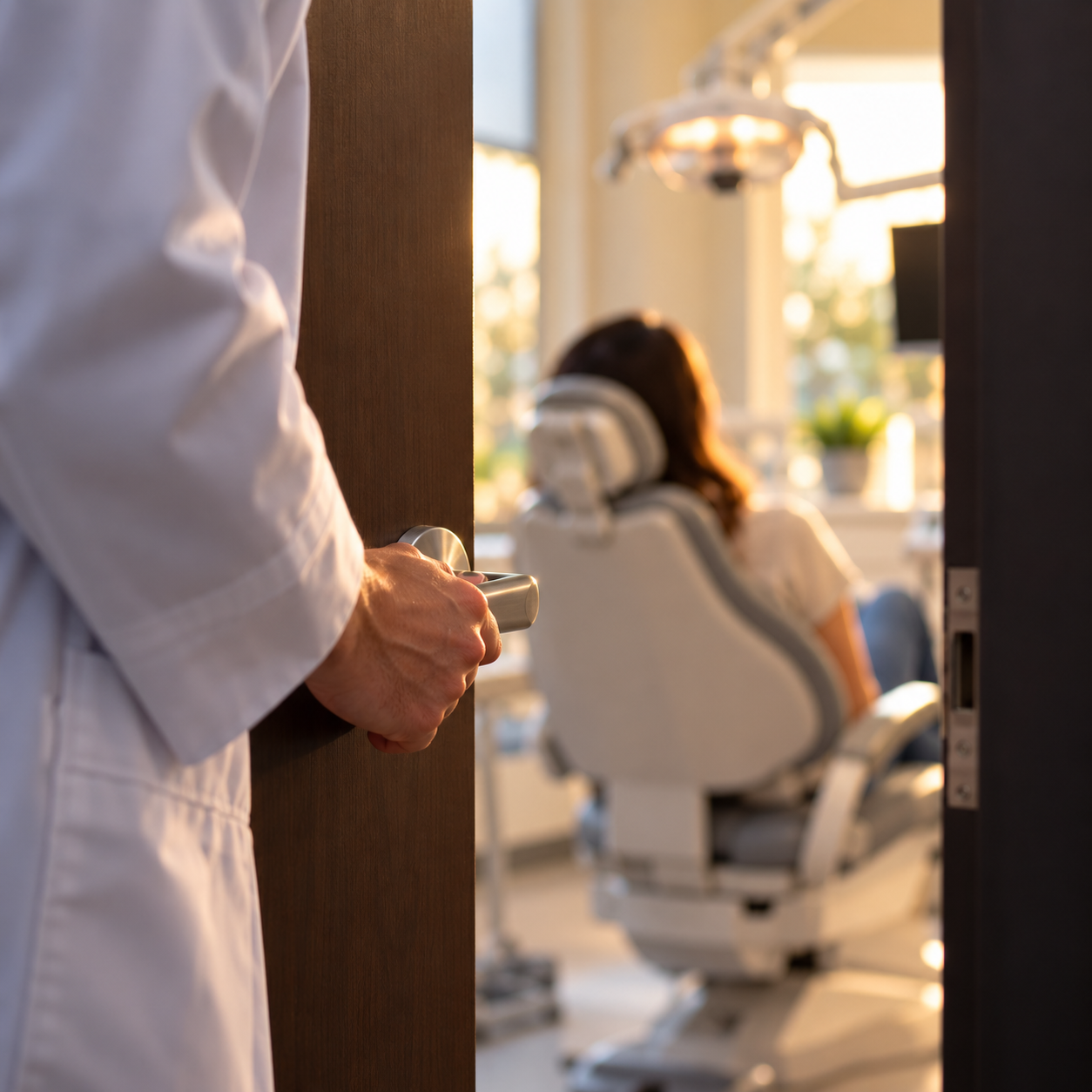
There is a very small moment that happens dozens of times in a dental practice. A dentist finishes with one patient.
Something happens in the hallway.
Someone asks a question.
The schedule changed while they were in the room.
There is a message waiting.
Maybe someone at the front needs a decision. Then they reach the next operatory. For a second, their hand is on the door.
On the other side is another patient. To the dentist, it might be the seventh appointment of the day. To the person sitting in the chair, it's their appointment.
I've been thinking about that distinction. The patient has no idea what happened during the six appointments before theirs. They don't know that someone arrived late this morning.
They don't know that another patient needed an extra fifteen minutes. They don't know that an insurance question came up, someone called out, tomorrow's schedule changed, or the front desk is waiting for an answer about something. And ideally, they shouldn't be able to tell.
Because their experience begins when that door opens. Maybe they've been nervous about this appointment for a week. Maybe they've been putting off treatment and finally decided to come in.
Maybe they're worried about what something will cost. Maybe they have one question they've been rehearsing in their head because they're embarrassed to ask it. Or maybe this is completely routine to them.
They still deserve the same thing. Someone who is actually in the room with them. That's one of the less obvious reasons operations matter.
We usually talk about operations in terms of efficiency.
How quickly can work move?
How many patients can the practice support?
How smoothly does the schedule run?
How much can the team accomplish?
Those questions matter.
But operations also influence where people's attention gets spent. And attention is part of the patient experience. A dentist only has so much of it.
So does an office manager.
So does the person answering the phone. So does everyone else working inside the practice. Every unnecessary question, unclear handoff, missing piece of information, unresolved task, or decision that reaches someone who didn't need to make it consumes a little bit of that attention.
Usually not much.
That's why it's easy to dismiss. One question in the hallway isn't a problem. One schedule change isn't a problem.
One message waiting at the front isn't a problem. One thing to remember isn't a problem. But human attention doesn't reset simply because someone walks through another door.
We carry things.
A thought from five minutes ago can still be running quietly while we're listening to someone in front of us. An unfinished problem can occupy a small part of the mind even when we're focused somewhere else. Sometimes we don't even notice it happening.
And then there is another patient. This isn't an argument for creating a dental practice where dentists are never interrupted.
That practice doesn't exist.
Healthcare is human.
Schedules change.
Patients arrive with unexpected needs.
Employees ask questions.
Things happen that genuinely require a doctor's judgment. Some interruptions are important precisely because the dentist is the person who should be involved. The goal isn't to eliminate those moments.
It's to be more thoughtful about everything else.
What really requires the dentist?
What simply requires an answer?
What needs their judgment?
What just needs someone to finish it?
What should follow them into the next room?
And what shouldn't?
Those distinctions become more important as a practice gets busier. Because growth creates more of everything.
More patients.
More calls.
More insurance questions.
More scheduling decisions.
More treatment conversations.
More follow-up.
More exceptions.
If every increase in activity also creates an increase in the number of things competing for the dentist's attention, eventually clinical capacity and mental capacity begin moving in different directions. There may still be another opening on the schedule. That doesn't necessarily mean there is another opening in someone's attention.
And patients can feel attention.
They may not describe it that way. They may simply say the dentist seemed rushed.
Or that someone really listened.
They may notice that the conversation felt personal. They may feel comfortable asking another question. They may leave feeling reassured rather than processed.
Sometimes those impressions are created by tiny moments. Eye contact that lasts another second.
A follow-up question.
Not reaching for the door while the patient is still speaking.
Remembering something they said earlier.
Actually hearing the concern underneath the question they asked. None of those things takes very long. But they require someone to be mentally available enough to notice.
That's where operational quality can become surprisingly personal. The benefit of reducing unnecessary friction isn't simply that the practice can accomplish more. Sometimes the benefit is that the people inside the practice have more of themselves available for the work only they can do.
The front desk can actually listen to the patient standing in front of them. The office manager can think through a difficult situation instead of reacting to five routine ones. The dentist can walk into an operatory without mentally finishing something that should never have followed them there.
And the patient gets something that's difficult to measure.
Presence.
Not performative friendliness.
Not a customer-service technique.
Not remembering a personal detail because someone wrote it in a note. Just the experience of having someone's attention while you're with them. For a patient, that can matter enormously.
Especially because dentistry is rarely just another transaction to the person in the chair.
Someone may be afraid.
Someone may be making a significant financial decision. Someone may have avoided treatment for years because of a previous experience. Someone may simply want to understand what's happening to their own body.
The dentist may have had six appointments already.
The patient hasn't.
That's why I keep coming back to that moment at the door. There is everything that happened before it. And there is the person waiting on the other side.
Good operations can't make every day easy.
They can't eliminate interruptions.
They can't make difficult patients disappear or prevent schedules from changing.
That's not the point.
But they can keep more unnecessary things from following people into moments where their attention matters more. So when the dentist opens that door, the patient doesn't get what's left of their attention.
They get them.