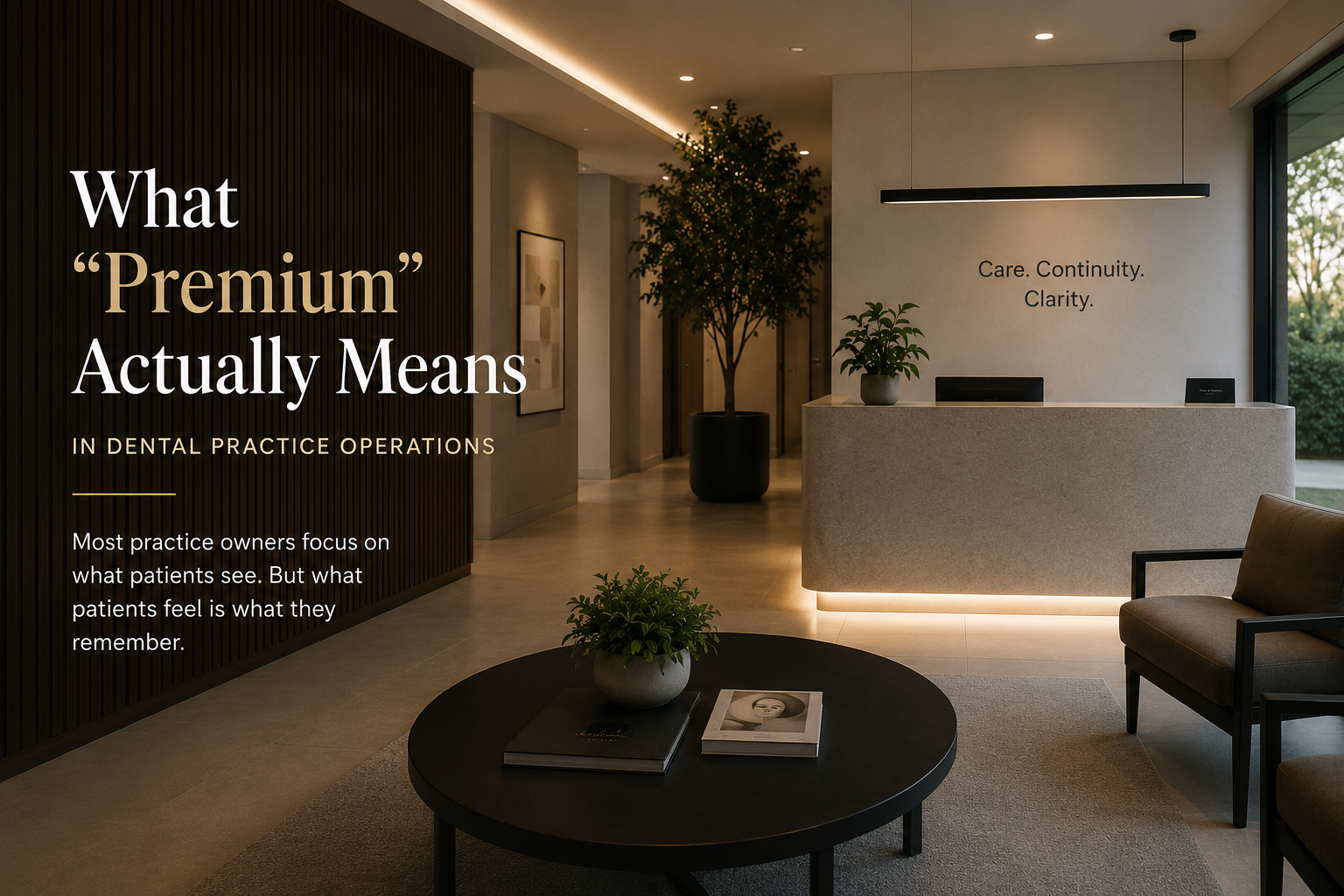
What "Premium" Actually Means In Dental Practice Operations
Most dental practices that want to be perceived as premium reach for the same set of signals.
Better finishings. Cleaner design. Updated waiting room. A more sophisticated logo. A website that doesn't feel like it was built in 2014. Marketing photography that shows the practice in its best light. Sometimes a rebrand, sometimes a renovation, sometimes both.
Some of this work helps.
The visual layer matters.
Patients form first impressions from environment, and an environment that signals care and intention reinforces the trust the practice is trying to build.
But the visual layer is the surface.
What patients actually experience as premium — what they describe to friends as that office is different or I just felt taken care of — is almost never about the visible aesthetics.
It's about something operationally specific that most practices don't think to optimize for.
What patients experience as premium is the absence of friction.
Not the absence of difficult conversations.
Not the absence of bad news about treatment costs or scheduling constraints.
Patients accept those things.
They're part of any healthcare relationship.
What patients respond to as premium is whether those difficult conversations happen cleanly — whether the office handles the small operational moments around them with continuity and intention.
A patient who calls to reschedule and gets a response that recognizes their case, references their last visit accurately, and offers options based on what's actually in their record, is experiencing premium.
The conversation might take ninety seconds.
The patient walks away feeling like the practice knows them.
A patient who calls to reschedule and gets a response that requires re-explaining who they are, what they came in for last time, and what their treatment plan was supposed to be, is experiencing the absence of premium.
The conversation might also take ninety seconds.
But the patient walks away feeling like just another caller.
The visible environment of those two practices could be identical.
Same furniture.
Same finishings.
Same lighting.
Same staff training.
What separates them is operational continuity — whether the practice has the infrastructure to make every interaction land cleanly, or whether each interaction is being reconstructed from scratch.
This is the part most practice owners don't see, because it doesn't show up in any of the visible metrics.
It doesn't appear in production reports.
It doesn't appear in patient satisfaction surveys, because patients usually can't articulate it.
It doesn't appear in online reviews, because patients describe the feeling — they really care about their patients or the office just runs well — without identifying the operational substrate that creates the feeling.
The cause and the effect become disconnected in the patient's own description.
But the feeling is real.
And the operational substrate that creates it is real.
This is what differentiates practices that compete on price from practices that compete on positioning.
Practices that compete on price are usually optimizing the visible layer — efficiency of treatment, throughput, scheduling density.
The supporting work happens in whatever margin remains.
Patients experience this as competence, not as care.
They might come back, but they're not loyal in the way that premium-positioned practices need them to be.
Practices that compete on positioning are usually optimizing the supporting layer first.
The visible work runs on top of a foundation of continuity that handles the small operational moments invisibly.
Patients experience this as care, even when they can't name what they're experiencing.
They become loyal in a way that doesn't require additional marketing investment to maintain.
The difference between those two practices isn't visible from the outside.
The lobbies might look the same.
The websites might be comparable.
The treatment quality might be identical.
What's different is what's happening underneath — the layer that absorbs the operational complexity so the patient never has to feel it.
Premium isn't a category you market into.
It's a category patients place you in based on how it feels to interact with you over time.
Owners who understand this stop trying to project premium and start engineering it.
They invest in the layer underneath the visible work.
They build infrastructure that handles the small moments well, consistently, across every patient touchpoint.
They let the surface layer take care of itself, because they know what the patient is actually responding to is happening a level deeper.
The practices that have figured this out usually aren't louder than their competitors.
They're not running more aggressive marketing.
They're not winning on price.
They're winning on the quiet, compounding effect of being the practice that always seems to know what's going on.
That's what premium feels like from the patient's side of the desk.
The practice didn't tell them it was premium.
It just was.