Your dental practice has a new audience.
It isn't sitting in your waiting room.
It may never visit your website the way a patient does.
And yet it could increasingly influence whether a patient discovers your practice at all.
That audience is machines.
For years, dental marketing largely revolved around two questions.
Can a search engine find the practice?
And once a patient arrives on the website, can that patient understand what the practice offers?
Those questions still matter.
But there is now another one:
Can an AI system understand your practice well enough to include it in an answer?
That sounds similar to search.
It isn't quite the same thing.
Search engines traditionally helped people find pages.
AI systems increasingly attempt to answer questions.
That difference matters.
A patient might once have searched:
"dental implants Houston"
and received a page of links to investigate.
Now that same patient can ask:
"Who does full-arch dental implants near me?"
"Which dentist nearby offers sedation for anxious patients?"
"Where can I find a dentist experienced with complex implant cases?"
Those questions require more than finding pages containing matching words.
The system has to make sense of information.
What does this practice actually do?
Where does it operate?
Who provides the care?
What services are genuinely offered?
What is the practice particularly relevant for?
How consistently does that information appear?
And is there enough confidence in the available information to use the practice as part of an answer?
This introduces a distinction that dental practices should understand:
Being visible is not necessarily the same as being understandable.
A website can be beautifully designed.
It can contain hundreds of pages.
It can rank for useful searches.
It can make perfect sense to a human visitor.
And still communicate the identity of the practice less clearly than the owner realizes.
Humans are remarkably good at inference.
We can read an About page, scan a provider biography, look at photographs, notice a few service pages, interpret navigation, and quickly form a mental model.
"This is an implant-focused practice."
"This office seems particularly comfortable treating anxious patients."
"This doctor appears to have extensive experience with complex restorative cases."
"This practice serves this part of the city."
We assemble meaning from fragments.
Machines have to assemble meaning too.
But ambiguity creates a different problem when the reader is a system trying to decide what information belongs in an answer.
That's why the next stage of dental visibility requires more than simply publishing more content.
It requires clarity.
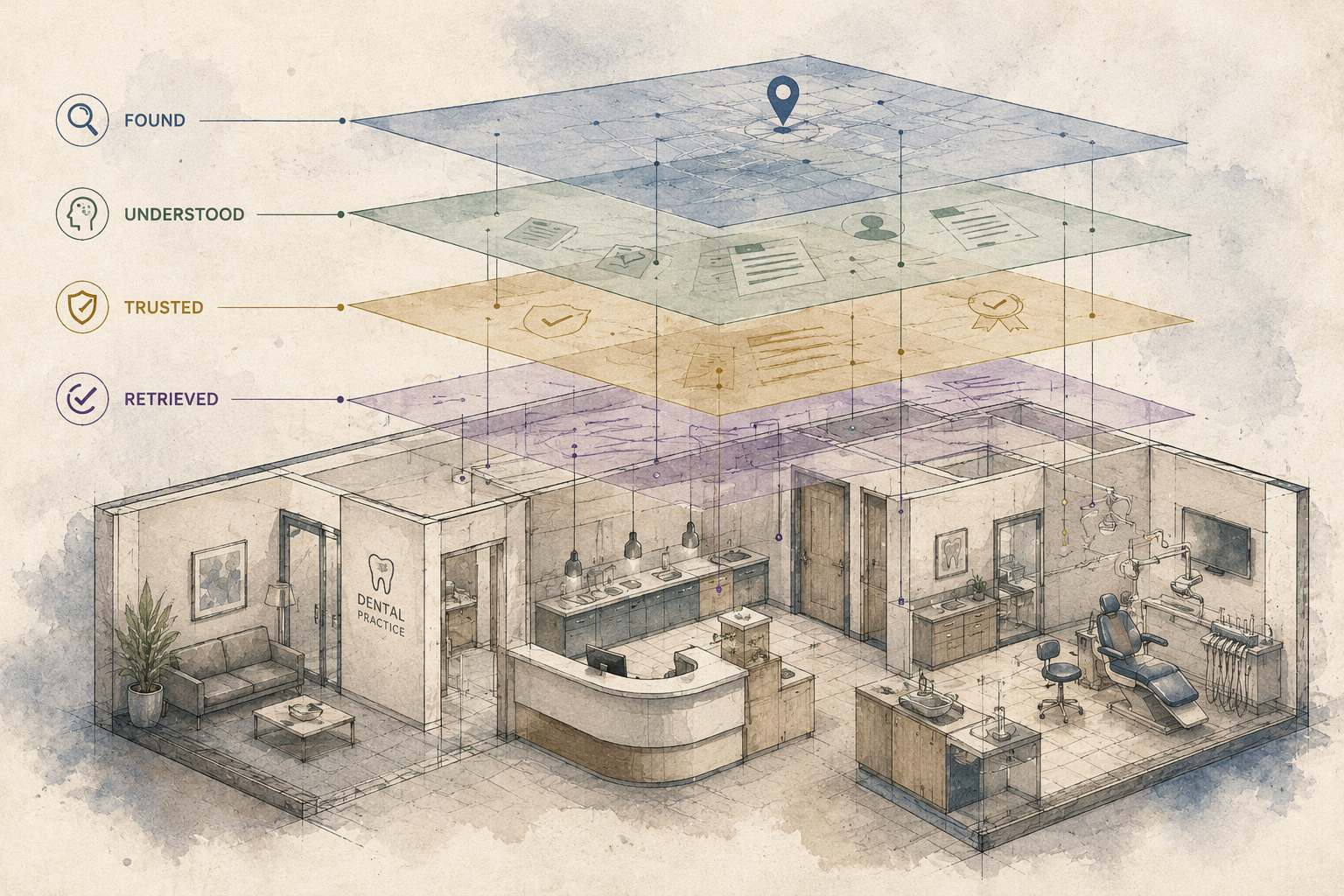
A useful way to think about this is through four layers:
Findability.
Understandability.
Credibility.
Retrievability.
Each solves a different problem.
FINDABILITY
Before information can influence discovery, it has to be accessible.
This is the layer dental marketers already understand well.
Can search systems discover the page?
Can they crawl it?
Is the content associated with the practice?
Does the site clearly communicate location and services?
Does useful information actually exist for the questions prospective patients ask?
If the answer is no, everything after this becomes difficult.
But being findable is only the beginning.
UNDERSTANDABILITY
Once information is discovered, a system has to make sense of it.
This is where many otherwise strong websites become surprisingly ambiguous.
Imagine a practice offering dental implants.
One page calls the service "implant dentistry."
Another refers to "tooth replacement."
A provider biography mentions advanced implant training.
A blog discusses full-arch rehabilitation.
The homepage says the practice offers "comprehensive restorative solutions."
A human can probably connect those ideas.
But the practice has made the reader do the connecting.
The clearer the relationships between the practice, its providers, its services, its location, and its areas of expertise, the easier it becomes to understand what the practice actually represents.
Clarity is not about repeating the same keyword everywhere.
It is about reducing unnecessary ambiguity.
CREDIBILITY
Understanding what a practice claims is different from having confidence in those claims.
A website can say almost anything about itself.
That makes consistency important.
Does provider information support the expertise being described?
Are services clearly explained?
Are names, locations, credentials, and practice information consistent?
Does the broader information surrounding the practice reinforce or contradict what the website says?
This isn't fundamentally an AI problem.
It is a trust problem.
AI discovery simply makes the structure of that trust increasingly important.
A machine trying to construct an answer has to decide which information is reliable enough to use.
The easier that information is to verify and reconcile, the stronger the foundation becomes.
RETRIEVABILITY
This may be the least familiar layer.
A page can exist.
A system can understand it.
The information can be credible.
And it still may not be the information selected when someone asks a particular question.
That's because discovery increasingly happens at the level of questions and answers rather than only pages and rankings.
Consider the difference between:
"Dental implants"
and:
"Can someone with significant bone loss still get dental implants?"
The first is a service.
The second is a question requiring specific knowledge.
If a practice has genuinely useful information addressing that question clearly, the content becomes easier to associate with that need.
That doesn't guarantee inclusion in an AI-generated answer.
Nothing does.
But it makes the information more useful for the kind of retrieval these systems increasingly perform.
This is why publishing twenty generic articles about dental implants may ultimately be less valuable than developing a coherent body of useful information around the real decisions implant patients face.
The objective isn't content volume.
It's information quality and clarity.
This changes the role of the dental website.
The website still has to persuade humans.
It still has to look credible.
It still has to communicate the practice's personality.
It still has to make scheduling easy.
It still has to answer patient questions.
None of that disappears.
But the site increasingly has another responsibility:
It has to represent the practice clearly enough that systems can make sense of it.
That means the future of dental content probably won't be won by publishing the largest number of articles.
It will be won by practices that build the clearest bodies of knowledge around what they actually know and do.
A practice with genuine expertise in implant dentistry should make that expertise structurally obvious.
A practice known for treating anxious patients should develop useful information around those patients' actual concerns.
A pediatric practice should make its relationship to pediatric dentistry unmistakable.
A multi-location organization should make the relationship between providers, services, and locations clear.
The objective is not to manipulate AI systems.
It is almost the opposite.
Remove ambiguity.
Make accurate information easier to understand.
Make expertise easier to verify.
Create genuinely useful answers to the questions patients ask.
Connect those answers coherently to the people and practice behind them.
That's good information architecture regardless of which technology reads it.
And that may be the larger lesson.
AI discovery isn't replacing the need for good dental marketing.
It's exposing how much good marketing has always depended on clarity.
The difference is that practices are no longer communicating exclusively with humans.
Patients are still the audience that ultimately matters.
But increasingly, there may be a machine standing between the patient's question and the practices they discover.
Your website has to communicate with both.
Being found matters.
Being trusted matters.
But in the next era of discovery, there is another requirement sitting between them:
Being understood.
— Luca